
SOUTH AFRICA’S TINY LEOPARDS
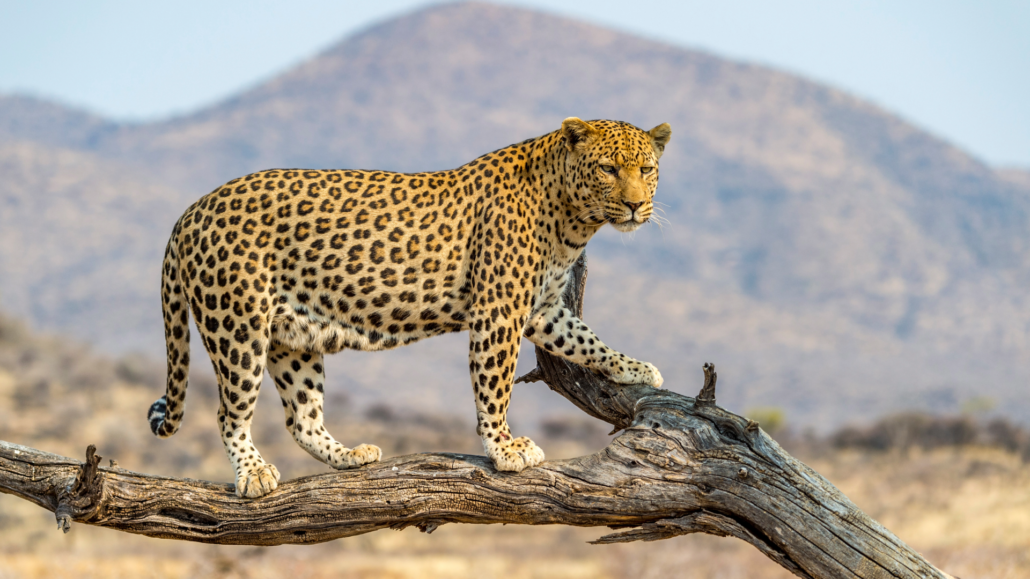
For decades, scientists have wondered why the leopards of South Africa’s Cape Floristic Region are so much smaller than their counterparts elsewhere in Africa. While leopards are known for their adaptability and wide distribution across the continent, the Cape population has long stood out because of its noticeably reduced size. New research has finally provided an answer, revealing that Cape leopards are not only smaller, but also genetically unique and specially adapted to their environment.
Researchers studied the complete genomes of Cape leopards and compared them with leopard populations from across Africa. By analysing genetic similarities and differences, they reconstructed the population’s evolutionary history. The results showed that Cape leopards have been largely isolated from other leopard populations for between 20,000 and 24,000 years. This isolation began during the Last Glacial Maximum, when cooler and drier conditions altered habitats and restricted animal movement across southern Africa. As a result, the Cape leopard population followed its own evolutionary path, gradually becoming distinct from other African leopards. The study found that Cape leopards form their own unique genetic group.
Unlike many small and isolated wildlife populations, however, they have managed to retain relatively healthy levels of genetic diversity. This is encouraging news for conservationists, as genetic diversity helps species adapt to environmental changes, resist disease, and maintain healthy populations.
Scientists also uncovered clues explaining the leopards’ smaller size. Around 90 genes linked to body size, muscle development, bone structure, and energy use were found to be more common in Cape leopards than in other populations. These traits appear to be adaptations to the unique conditions of the Cape Floristic Region, where prey is smaller and often less abundant than in other parts of Africa. Unlike leopards elsewhere that frequently hunt larger antelope species, Cape leopards survive mainly on smaller animals such as rock hyrax, klipspringer, and Cape grysbok.
A smaller body size likely requires less energy, giving these predators an advantage in a landscape where food resources are limited. Over thousands of years, natural selection appears to have favoured smaller, more efficient animals. Today, fewer than 1,000 Cape leopards are believed to remain in the wild. They occupy mountainous areas across parts of the Western Cape, Eastern Cape, and Northern Cape.
Their survival is increasingly threatened by habitat fragmentation, road fatalities, poaching, and conflict with humans. Researchers say the findings highlight the importance of protecting this unique population. Because Cape leopards represent a distinct evolutionary lineage, conserving them means preserving thousands of years of natural adaptation and genetic history.
Source: SciTechDaily